
Amelia Nin: “You Don’t Have to Wait Until You Feel Completely Ready to Begin”

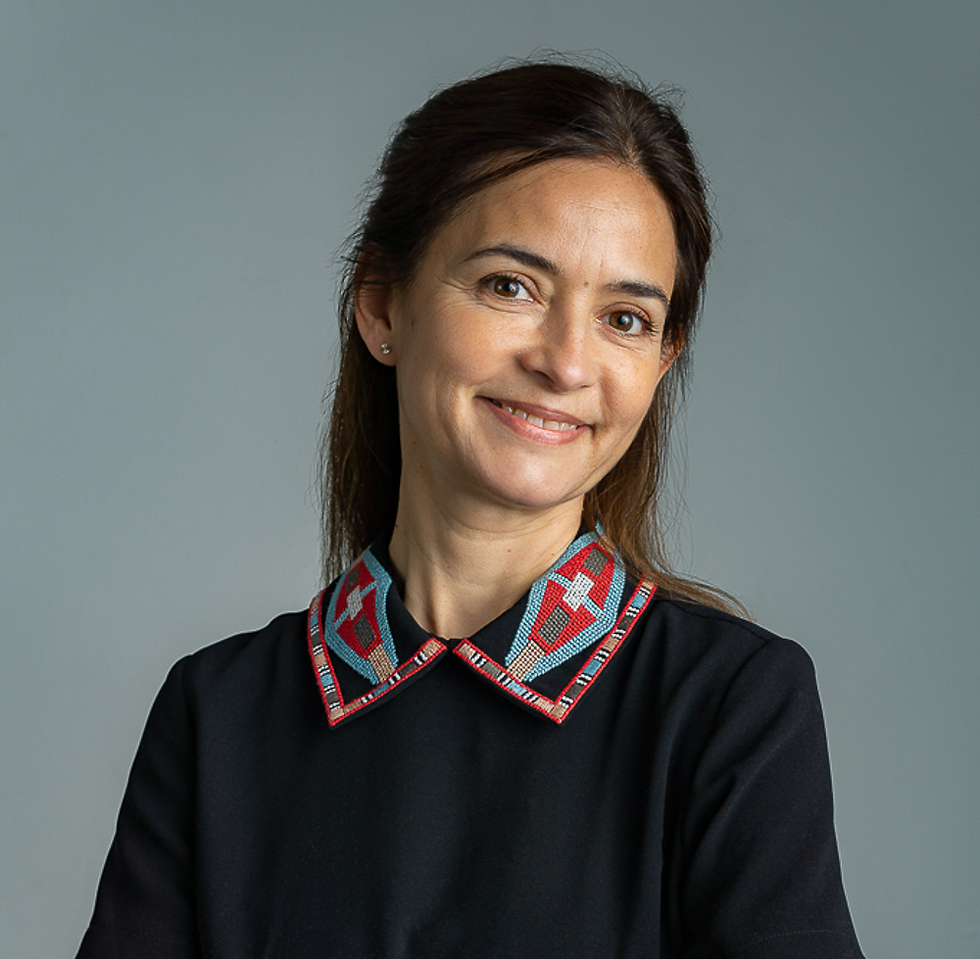
As part of our campaign for Frauenalia’s 10th anniversary, “10 Frauen, 10 Stimmen,” today we introduce you to Amelia Nin. She is a Uruguayan textile artist who came to Berlin in 2007 to study textile art. Today, after almost twenty years in Germany, she makes a living from her art and from the workshops she teaches.
A Family of Creative Hands
Amelia grew up in Uruguay in a family where handcraft, art and passion for a calling were essential. Her grandfather painted, worked with ceramics and wove on a loom. From her grandmother she learned to knit, embroider and sew. Her parents started a project to restore the country’s native flora and saved several endangered species.
“From them I inherited the tenacity to fight for a dream,” Amelia says.
Before textiles, she studied classical ballet for more than ten years. She decided not to become a professional dancer, but she kept an important lesson: discipline, rigor, and the awareness that things never work out on the first try. She then studied textile design and worked for ten years as a designer in Uruguay and Mexico City.

The Emptiness That Changed Her Direction
The change began in Mexico. Although she worked in her field, she felt empty and couldn’t find meaning in what she did. Her company sent her to the most important textile fairs in Europe, where she discovered other ways of working with materials.
“I realized that this was what I wanted to do: experiment, try new things, do what I was truly passionate about,” she remembers.
It meant walking an unknown and unconventional path.
Berlin: Starting Over, Alone and Without the Language
Amelia arrived in Berlin in October 2007 with the plan of doing a master’s degree in textile art. The beginning wasn’t easy: she was alone and had no support network. What weighed on her most was the language. Learning it was much slower than she had imagined, and it hit her self-esteem.
“I was afraid of making mistakes and being judged. So I didn’t speak, and it was a vicious circle,” she explains.
She married a German man who spoke perfect Spanish and lived in a bubble for a long time. She drifted away from her original goal and, in her words, lost herself. Then motherhood arrived, which made things even harder.
“I had to hit rock bottom to find myself again and recover my original motivation.”
Little by little, she learned to leave the bubble and to stop seeing being a migrant as a disability. For her, the hardest part was handling three things at once: mastering the language, decoding the work culture, and rebuilding her professional identity without losing the connection to her story and her home country.
Living From What She Creates

Today Amelia sustains her work by selling unique textile pieces and teaching in-person workshops in community spaces and educational institutions. She also takes part in fairs, exhibitions and curated projects. Her approach is slow, careful production, without depending on a single sales channel.
Her studio is much more than a workplace: “It’s a space of refuge and creation where I can express myself freely. A place with a certain magic, where ideas take shape.”
The most challenging part, she says, was the business side: learning to sell, setting fair prices and organizing her time. “Because my work is so personal, I feel that I am the product.” The most beautiful part: sitting in her studio every day to create, and seeing people connect emotionally with her work.
Advice for Those Who Are Afraid to Start a Business
“Fear will always be there, but you don’t have to wait for it to disappear to begin. Starting a business also means daring to take small steps, even with doubts and insecurities.”
To women who arrive in Germany today and feel lost or alone, she says: you are not alone, even if it seems that way at first. “Asking for help is not a weakness. On the contrary, it’s a way of taking care of yourself.”
Frauenalia: Phoenix

Amelia found Frauenalia through a migrant friend, the mother of a classmate of her son at daycare, who told her how much a course had helped her. “Most migrant mothers share this problem: our children grow up and we want to go back to our professional activity,” she says.
At Frauenalia she found a safe space to work on her fears, insecurities, time management, and her relationship with money and with the value of her work. Besides emotional support, she received concrete tools to organize her business idea and turn it into a real, sustainable plan.
The moment that marked a before and after was the closing exhibition of module 4. “That’s when I realized how much I had grown and that there was no turning back.”To any woman thinking of taking part, she would say that she will feel accompanied, heard and supported. And if she had to define Frauenalia in one phrase: “Phoenix. Being reborn with more strength and confidence.”
For Frauenalia’s 10th anniversary, she would give “an infinite echo so that its message reaches further.”
Amelia Nin’s story is part of “10 Frauen, 10 Stimmen,” Frauenalia’s campaign for its 10th anniversary: ten women, ten stories and many ways of making your way in Germany.


Comments